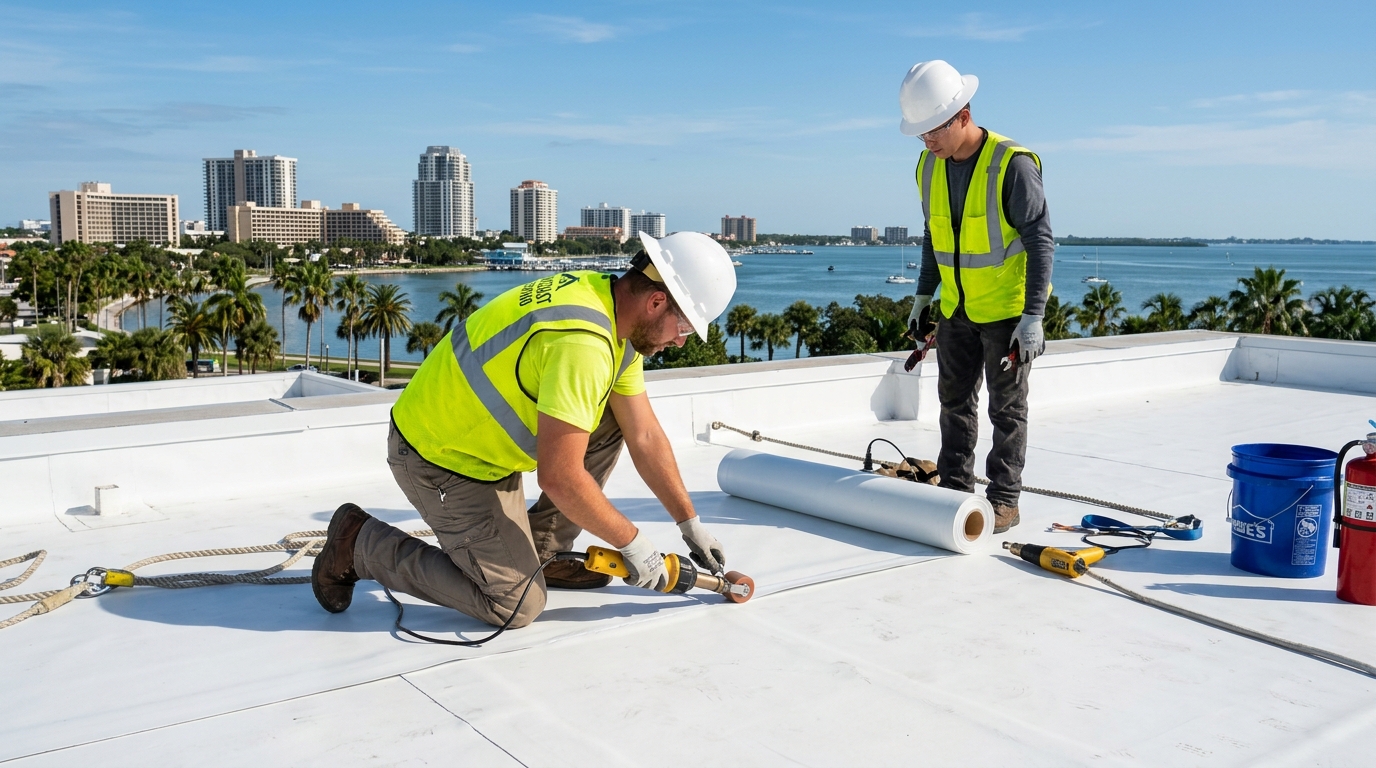
Commercial Standing Seam Hail Dent Patch
Emergency drainage restoration, heat-welded thermoplastic membrane patch application, and non-destructive mechanical seam re-crimping on Galvalume standing seam panels.
1. Regional Microclimate Dynamics & Severe Storm Exposure in South-Central Kansas
Wichita's geographic exposure along the Arkansas River basin creates a highly volatile meteorological microclimate. Convective supercells originating over the High Plains of western Kansas accelerate rapidly eastward along the U.S. Route 54 / Kellogg Avenue corridor, fueled by intense summer solar radiation and low-level moisture advection. In Sedgwick County, these storms generate extreme downdraft divergence fields, resulting in sudden straight-line winds exceeding 80 MPH and torrential downpours dumping over 2 inches of precipitation in thirty minutes.
The sheer kinetic velocity of wind-driven precipitation exploits the slightest mechanical weakness in the roofing envelope. As asphalt shingles age under intense High Plains ultraviolet radiation, their elastomeric asphalt sealants lose plasticity, rendering them brittle. When microburst winds lift shingle tabs, the factory seal releases with an audible snap. Horizontal rain is forced backward under the shingles, overwhelming standard organic underlayment and soaking structural plywood subdecking, causing rapid moisture saturation of attic cellulose or fiberglass batt insulation.
2. Non-Destructive Moisture Diagnostics & FLIR Thermal Tracing
Locating the true entry point of a storm-induced roof leak requires specialized diagnostic equipment. Water rarely penetrates directly above an interior ceiling stain; instead, it travels along roof trusses, top plates, electrical conduits, and air ducts before pooling in the lowest drywall deflection. Visual inspections alone cannot detect trapped moisture within structural cavities, leading to hidden rot and toxic mold growth if left unaddressed.
Network contractors deployed through our Wichita dispatch desk utilize calibrated FLIR infrared thermal imaging cameras to conduct non-destructive moisture mapping. By capturing minute evaporative cooling differentials between wet and dry substrate materials, infrared thermography displays real-time thermal heat maps revealing exact water intrusion pathways. Technicians confirm these thermal readings with non-invasive radio-frequency moisture meters, establishing quantifiable boundary maps of saturated wood decking and insulation without damaging sound roofing surfaces.
Key Technical Protocols — Commercial Standing Seam Hail Dent Patch
- Thermal Differential Analysis: Calibrated FLIR infrared camera scans detect thermal thermal conductivity differentials as small as 0.05°C, tracing subsurface moisture migration beneath shingles and membrane seams.
- Pinless Substrate Moisture Profiling: Multi-depth electronic moisture meters verify percentage saturation levels across OSB decking, plywood sheathing, and underlying ceiling joists.
- HAAG Engineering Test Squares: Standardized 100 sq ft forensic sample areas on all cardinal roof slopes document precise counts of fractured fiberglass mats and asphalt bruising.
- Digital Collateral Spatter Indexing: Photographic documentation of directional hail impact patterns on copper flashings, soft aluminum gutters, and air conditioning condenser fins.
3. Step-by-Step Substrate Restoration Methodology
Executing reliable storm mitigation demands methodical, step-by-step engineering execution that halts progressive water damage while establishing the groundwork for permanent code-compliant restoration:
- Rapid Structural Envelope Stabilization: Dispatched crews establish OSHA-compliant tie-offs and install heavy-duty 10-mil woven poly tarps over storm breaches. Securing battens of 2x4 kiln-dried spruce are fastened mechanically through to the underlying roof rafters, eliminating flapping and water ponding.
- Defective Material Demolition & Sheathing Inspection: Compromised shingles, torn organic felts, and corroded valley metals are carefully stripped back to reveal sound structural framing. Plywood or OSB panels exhibiting rot, delamination, or fastener blow-out are marked for structural replacement.
- Subdecking Reinforcement & Ice Barrier Application: New exterior-grade CDX plywood is mechanically fastened with ring-shank nails at 6-inch perimeter intervals. Self-adhering polymer-modified bitumen ice and water barrier underlayment is laminated across critical valleys, eaves, and sidewalls.
- High-Wind Fastener & Shingle Installation: New Class 4 impact-resistant architectural shingles or commercial standing seam panels are aligned to manufacturer specifications. In compliance with Wichita high-wind codes, six nails per shingle are hand-driven beneath the sealant strip.
- Perimeter Reglet Counter-Flashing & Quality QA: Masonry reglets are cut to 1-inch depth, receiving new 24-gauge pre-finished counter-flashing sealed with non-sag polyurethane mastic. A final quality assurance audit confirms zero moisture retention.
4. State Energy Efficiency Codes & Contractor Licensing Compliance
All roofing restoration work coordinated through our dispatch network complies strictly with the Kansas Roofing Contractor Registration Act (K.S.A. 50-6,121) and local building amendments enforced by the Metropolitan Area Building and Construction Department (MABCD) of Wichita and Sedgwick County. Under Kansas state law, roofing contractors must maintain active registration with the Attorney General's Office, demonstrating compliance with state business registry, workers' compensation insurance, and minimum ,000,000 commercial general liability standards.
Building codes in Wichita mandate adherence to the 2018/2021 International Residential Code (IRC) with local Sedgwick County amendments. Key engineering requirements include a minimum basic design wind speed rating of 115 MPH (3-second gust exposure category C), mandatory installation of ASTM D1970 ice barrier membranes extending 24 inches past the interior wall plane, and 26-gauge corrosion-resistant metal drip edge installed along all eave and rake perimeters. Adhering to these strict municipal specifications guarantees that restorations maintain homeowner insurance coverage and manufacturer warranty validity.
5. Preventative Property Maintenance & Storm Preparedness
While severe High Plains convective squalls cannot be predicted with total precision, proactive preventative maintenance significantly enhances roof resilience against violent wind and hail impacts:
- Biannual Flashing & Sealant Audits: Inspect chimney counter-flashings, skylight curb transitions, and plumbing stack boots every spring and autumn to replace degraded elastomeric mastics before freeze-thaw cycles expand fissures.
- Canopy Trimming & Limb Clearance: Maintain a minimum 10-foot clearance zone between overhanging oak, elm, or maple tree branches and the roof surface to prevent mechanical abrasion and puncture hazards during severe windstorms.
- Gutter & Downspout Debris Management: Clean gutters and downspout leaders regularly to eliminate hydrostatic back-pressure and prevent ice damming along eave lines during winter thaw events.
- Post-Storm Visual Ground Scoping: Following severe weather, inspect gutter discharge screens for heavy accumulations of asphalt granules and walk property perimeters to spot displaced shingle tabs or dented air conditioning condenser fins.
Need Immediate Emergency Assistance in Wichita?
Connect directly with our 24/7 Wichita emergency dispatch desk. Vetted on-call Kansas roofing contractors are ready to deploy to your property.
CALL NOW: (888) 208-4155